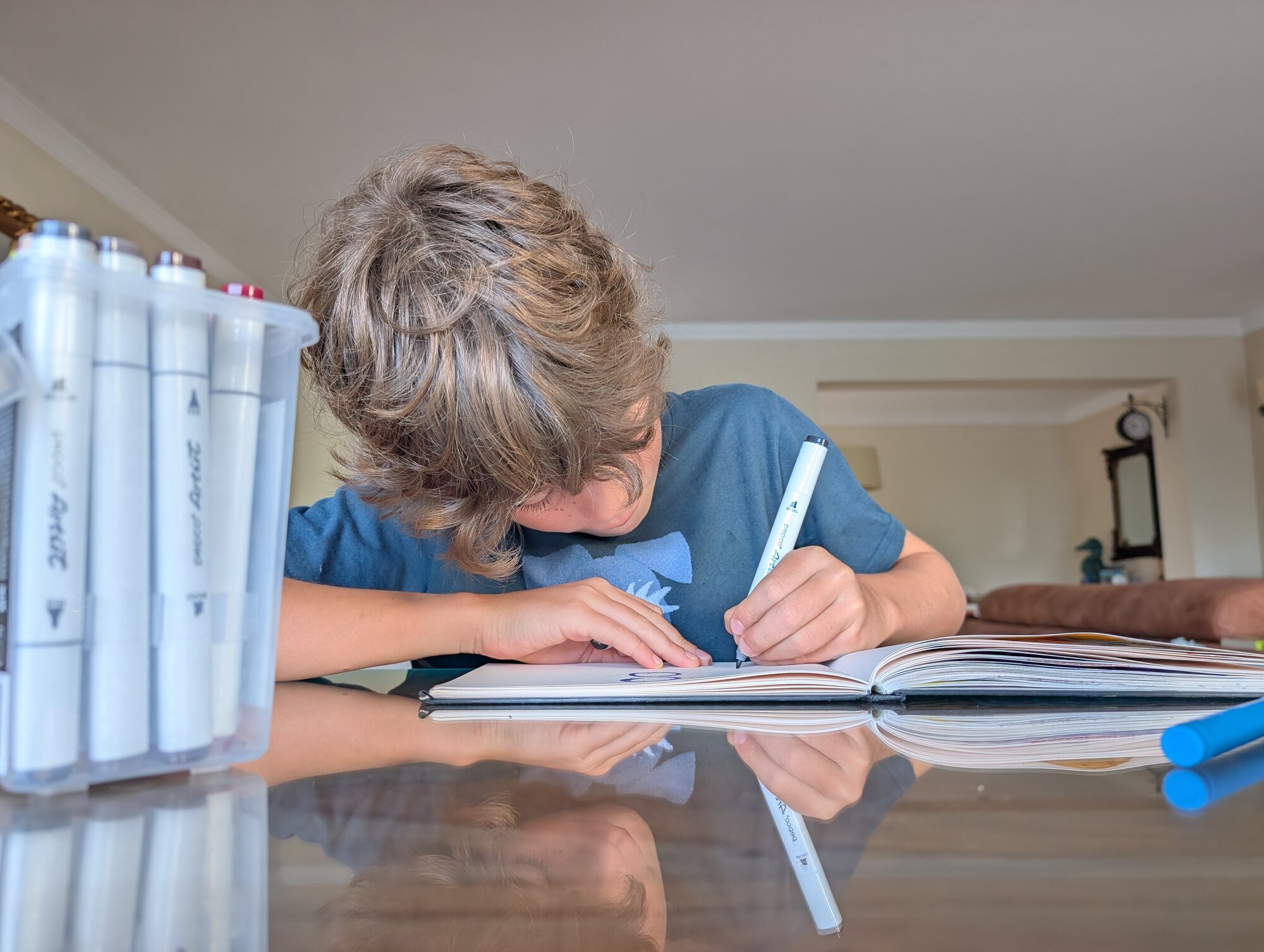
The Early Years has traditionally been a space that values childhood, curiosity, play and development in all its messy, unpredictable forms. For many, it has felt like a refuge from the relentless focus on handwriting, Spelling, Punctuation, and Grammar (SPaG) and measurable outcomes that dominate elsewhere in the system.
But the landscape is changing. Enter the government document ‘The Writing Framework’.
“Handwriting instruction should start at the beginning of reception, alongside phonics, and continue throughout the reception year and beyond.”1
As early years practitioners, we all know that early writing development is far more than putting pen to paper; it is critical that we spend time laying the foundations for comfortable, legible and expressive writing through a broader process - climbing, oral storytelling, malleable play etc. Education Consultant, Ruth Swailes has written a great piece on this topic which you can read here.
In terms of the physical act of writing - when ready, given the freedom and correct support, children will often choose to write with enthusiasm. An adult obsession with letter formation, finger spaces, capital letters and full stops, before developmentally appropriate, will be sure to erode the desire to write. It can be argued that a desire to write is the most important aspect of writing development. Without it, children simply won’t write as much. If they don’t write, they don’t practise, and if they don’t practise, handwriting and composition suffer.
Yet here we are again, preparing children for their future rather than letting them live out what is developmentally appropriate at that moment. A renewed focus on reception handwriting is often cited as a tool to get children “year one ready”; this persistent focus on “getting ready” is taking away from the significance of their present moment.
The supposed point of handwriting is to enable the writer to get their message across clearly. Firstly, writing is not the only form of communication but secondly, at the age of 4 and 5 (and perhaps beyond), children are indifferent about legibility but instead, are focused on the intention of their writing, in any given moment. In my experience a child who is writing a label, their own story or a postcard is not too concerned with whether others can read it but instead rooted in the present experience, it is process driven. If a child makes a label that they read as ‘police officer’, they will spend little to no time worrying about legibility but instead understand that marks and symbols have meaning and recognise that the label is building on the world they are creating.
Unfortunately, and to the detriment of childhood - despite the writing framework being labelled as ‘guidance’, senior leaders will now feel that they ignore it at their peril - another stick for Ofsted to beat us with perhaps? As a result, this document becomes yet another straitjacket for practitioners, who are attempting to find small pockets of joy in an increasingly compliance driven, adult controlled education world. It is my concern that with this latest writing document, handwriting sessions will become commonplace in reception classrooms - a sure fire way to place barriers between children and their writing motivation and delight.
Teachers can inspire children to write and children can find joy and purpose in their writing. We just need to trust them.
Read my piece on learning to read here.
Read The Writing Framework here.
References
- DfE. July 2025. The Writing Framework.